Optimal transport distances to characterise electronic excitations
Annina Z. Lieberherr,∗,† Paola Gori-Giorgi,‡,¶ and Klaas J. H. Giesbertz‡
E-mail: annina.lieberherr@chem.ox.ac.uk
Abstract
Understanding the character of electronic excitations is important in computational and reaction mechanistic studies, but their classification from simulations remains an open problem. Distances based on optimal transport have proven very useful in a plethora of classification problems and seem therefore a natural tool to try to tackle this challenge. We propose and investigate a new diagnostic
1 Introduction
Electronic excitations drive various processes, for example in light harvesting or solar cells, which are important in the exploration of alternative energy sources. 1,2 There is consequently significant theoretical interest in calculating excited states and their energies, which could then be used to drive non-adiabatic dynamics and design novel materials. However, excited state calculations are a computationally expensive problem, and various approximations have been introduced to obtain solutions at lower costs. Similarly to the ground state problem, methods based on density functional theory (DFT) have become highly popular as they come at a relatively low computational cost but have a solid theoretical foundation, except for approximations that have to be made to the density functional. 3 Despite decades of effort, there is no ‘one-fits-all’ density functional. 4 In particular for electronic excitations in time-dependent DFT (TDDFT), 5 where transition energies are calculated within the linear response setting, it has become clear that a functional’s performance can depend heavily on the character of the excitation. 6
This is one of the main motivations behind exploring diagnostics that split TDDFT calculated excitations into different types, 7,8 of which there are three. First, Rydberg excitations to energetically high lying and diffuse Rydberg states. Secondly, charge transfer (CT) excitations from a donor to an acceptor which is spatially separated from the donor, either within the same molecule (intramolecular) or in different molecules (intermolecular). CT excitation can carry especially large errors in TDDFT calculations. 6 The third group are local excitations, which encompass excitations that fit neither of the other two categories. With a classifier one can decide a posteriori whether the chosen density functional was suitable and if not, repeat the calculation with a higher-level functional. However, such a classification might prove useful beyond picking the right functional. Assigning a label to a new excitation can be a very tedious process, during which one relies on chemical intuition or has to inspect wavefunctions and/or localised orbitals visually. With a quantitative method to decide on the character of the excitation, this step could be extremely simplified. 9
To this end, Peach et al. took advantage of the decomposition of an electronic excitation into single orbital transitions within the TDDFT framework and studied a weighted average of the overlap between initial and final orbitals. 7 While they did not establish a classification of excitation types, they showed a correlation between their overlap diagnostic and the associated error in excitation energy. The same trends have been observed in other systems and the overlap diagnostic has been widely applied since its introduction. 10–12 In a similar spirit Guido et al. studied the difference between the electron’s centroid in the initial and final orbitals within a single orbital transition. 13 The centroid difference is better able to differentiate between CT and valence excitations than the overlap diagnostic, although they stress that the best results were obtained when using them in combination.
An alternative interpretation of electronic excitations that extends beyond the TDDFT framework is via the formation of an electron-hole pair (the exciton). The resulting exciton formalism opens the door for a multitude of other descriptors like the electron-hole correlation, the distance between them and the size of the exciton. All have been used to characterise excited states 8,14 and the latter two have been combined with the overlap diagnostic for classification. 9 However, Hirose et al. also point out that the electron-hole correlation cannot describe centrosymmetric molecules. 9 To summarise, while there exist different descriptors for electronic excitations, there is no generally applicable classifier as of yet. Finally, going back to a density picture in the TDDFT framework, Moore et al. consider the modulus of the change in electron density between the initial and final orbitals, which they argue is better suited for a classification. 15 However, this diagnostic suffers from a similar problem as the overlap: If the supports of the initial and final orbitals become disjoint, there is a plateau value for both of them and they are agnostic to any variations in the orbitals at that point.
In this work, we seek to improve the classification of excitations by considering optimal transport properties of electron densities, which promise to avoid the plateau problem. The article is structured as follows. After laying out the necessary theory on TDDFT and optimal transport in Sec. 2, we cover the computational details in Sec. 3. In Sec. 4, we present the results, both confirming previous studies on the overlap diagnostic and new results using descriptors from optimal transport. Finally, we summarise our findings in Sec. 5 and propose future directions.
2 Theory
2.1 TDDFT and the
The Kohn–Sham (KS) ground state for an
where
The ground state is composed of the KS orbitals
The eigenvalues
It is generally difficult to assign one of the labels ”CT”, ”local” or ”Rydberg” to a given electronic excitation. Peach et al. investigated energy errors in electronic excitations based on the overlap of the single orbital transitions, 7
where
2.2 An Optimal Transport diagnostic
At the heart of optimal transport lies the problem of finding a plan to transport a source probability density into a target probability density. 19 As we will be looking at electronic orbitals
where
and we use the regularised optimal transport problem problem with the Kullback-Leibler divergence
for computational efficiency. 20 Because of the entropic regularisation, Eq. (5) can unituitively be non-zero even if the orbitals
which will therefore be used from here on.
Fig. 1 motivates the use of the Sinkhorn divergence to study electronic excitations: Consider the case where the target density
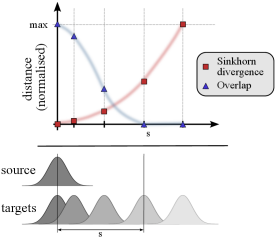
Figure 1: (Qualitative) demonstration of overlap measurements and the Sinkhorn divergence when studying translations, here for Gaussian source and target densities.
with the single orbital contribution
3 Computational details
We calculated m3 was used for the DFT calculation. 28 At the end of a converged TDDFT calculation, Turbomole prints a list of single orbital contributions geomloss package (version 0.2.5). 29 In order to calculate Sinkhorn divergences, the orbital grids have to be chosen large enough to contain all electronic density (in practice, we chose the grids big enough to contain at least 99% of the density). We use an equidistant grid with spacing of 0.8 Bohr for all molecules.
We will use a
4 Results and Discussion
4.1 The dataset
The calculated excitation energies,
4.2 Optimal transport results
The regularisation parameter
with integer
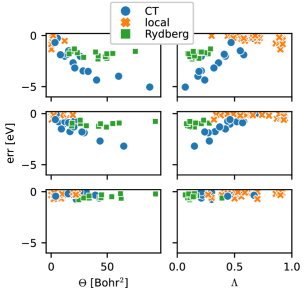
Figure 2: Comparison of
To start, we compare both
Turning our attention to CT excitations, we note that, contrary to our expectations, the CT

(a)

(b)

(c)
Figure 3: Confusion matrix of a
Instead, we could take advantage of the opposite trends of
To understand better why, let us consider the regions of overlap of CT excitations with local and Rydberg excitations, respectively. Rydberg and CT excitations might be difficult to distinguish with the diagnostics used here because there is a property that is completely ignored: diffusivity. We do not have the ability to discern an excitation into a diffuse orbital from one into a translated orbital. Additional metrics that can identify Rydberg orbitals, such as the average distance of the electron to the center of the molecule or higher order moments, might provide a better classification in combination with
One good example of coinciding CT and local excitations are the CT excitations in the HCl molecule. Since the excitations only take place across one hydrogen-chloride bond, the associated Sinkhorn divergences are very small
We have now pointed out multiple times that there are opposite trends in
with a constant
with
and we have assumed that the center of the molecule lies at the origin. Plotting the new
Fig. 5 shows the confusion matrices for
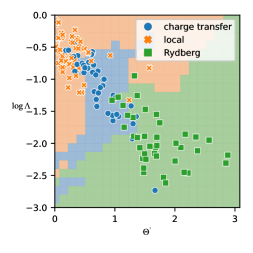
Figure 4: Combined plot of

(a)

(b)

(c)
Figure 5: Confusion matrix of a
5 Conclusion
There is currently no reliable way to classify electronic excitations into CT, Rydberg and local excitations. In this report we studied two diagnostics, the overlap-based
We then showed that there is an apparent relation between
While this work was being finalised, a study that shares similar ideas has appeared. 31 We reach similar conclusions, but we have also key differences, like the use of the entropic regularisation to accelerate calculations and a different look at possible classifications.
Acknowledgement
The authors thank Stijn de Baerdemacker for pointing out Eq. (11), David Tew for helpful comments and advice on the Turbomole calculations, Joe Cooper for helpful discussions about Rydberg excitations, Giulia Luise for helpful discussions about the Sinkhorn divergence as well the geomloss package, Derk Kooi for advice on the initial version of the Sinkhorn algorithm, and Hans Chan for helpful suggestions on the manuscript. Annina Lieberherr was supported by a Berrow Foundation Lord Florey Scholarship and, during the initial phase of this work, by the University Research Fellowship at the Vrije Universiteit Amsterdam.
Supporting Information Available
The supplementary information shows the molecules considered here, the convergence of si_data.csv.
References
(1) Scholes, G. D. Introduction: Light Harvesting. Chemical Reviews 2017, 117, 247–248.
(2) Hagfeldt, A.; Boschloo, G.; Sun, L.; Kloo, L.; Pettersson, H. Dye-Sensitized Solar Cells. Chemical Reviews 2010, 110, 6595–6663.
(3) Cancès, E., Friesecke, G., Eds. Density Functional Theory; Springer International Publishing, 2023.
(4) Medvedev, M. G.; Bushmarinov, I. S.; Sun, J.; Perdew, J. P.; Lyssenko, K. A. Density functional theory is straying from the path toward the exact functional. Science 2017, 355, 49–52.
(5) Ullrich, C. A. Time Dependent Density Functional Theory; Oxford Graduate Texts, 2006.
(6) Maitra, N. T. Charge transfer in time-dependent density functional theory. Journal of Physics: Condensed Matter 2017, 29, 423001.
(7) Peach, M. J. G.; Benfield, P.; Helgaker, T.; Tozer, D. J. Excitation energies in density functional theory: An evaluation and a diagnostic test. The Journal of Chemical Physics 2008, 128, 044118.
(8) Mewes, S. A.; Plasser, F.; Dreuw, A. Communication: Exciton analysis in time-dependent density functional theory: How functionals shape excited-state characters. The Journal of Chemical Physics 2015, 143, 171101.
(9) Hirose, D.; Noguchi, Y.; Sugino, O. Quantitative characterization of exciton from GW+Bethe-Salpeter calculation. The Journal of Chemical Physics 2017, 146.
(10) Dev, P.; Agrawal, S.; English, N. J. Determining the appropriate exchange-correlation functional for time-dependent density functional theory studies of charge-transfer excitations in organic dyes. The Journal of Chemical Physics 2012, 136.
(11) Leang, S. S.; Zahariev, F.; Gordon, M. S. Benchmarking the performance of time-dependent density functional methods. The Journal of Chemical Physics 2012, 136.
(12) Kornobis, K.; Kumar, N.; Wong, B. M.; Lodowski, P.; Jaworska, M.; Andruniów, T.; Ruud, K.; Kozlowski, P. M. Electronically Excited States of Vitamin B12: Benchmark Calculations Including Time-Dependent Density Functional Theory and Correlated ab Initio Methods. The Journal of Physical Chemistry A 2011, 115, 1280–1292.
(13) Guido, C. A.; Cortona, P.; Mennucci, B.; Adamo, C. On the Metric of Charge Transfer Molecular Excitations: A Simple Chemical Descriptor. Journal of Chemical Theory and Computation 2013, 9, 3118–3126.
(14) Mewes, S. A.; Dreuw, A. Density-based descriptors and exciton analyses for visualizing and understanding the electronic structure of excited states. Physical Chemistry Chemical Physics 2019, 21, 2843–2856.
(15) Moore, B.; Sun, H.; Govind, N.; Kowalski, K.; Autschbach, J. Charge-Transfer Versus Charge-Transfer-Like Excitations Revisited. Journal of Chemical Theory and Computation 2015, 11, 3305–3320.
(16) Kohn, W.; Sham, L. J. Self-Consistent Equations Including Exchange and Correlation Effects. Physical Review 1965, 140, A1133–A1138.
(17) Casida, M. E. Recent Advances in Density Functional Methods; WORLD SCIENTIFIC, 1995; pp 155–192.
(18) Toulouse, J. Density Functional Theory; Springer International Publishing, 2022; pp 1–90.
(19) Peyré, G.; Cuturi, M. Computational Optimal Transport: With Applications to Data Science. Foundations and Trends® in Machine Learning 2019, 11, 355–607.
(20) Cuturi, M. Sinkhorn distances: Lightspeed Computation of Optimal Transport. Advances in Neural Information Processing Systems 2013,
(21) Ramdas, A.; Trillos, N.; Cuturi, M. On Wasserstein Two-Sample Testing and Related Families of Nonparametric Tests. Entropy 2017, 19, 47.
(22) Balasubramani, S. G. et al. TURBOMOLE: Modular program suite for ab initio quantum-chemical and condensed-matter simulations. The Journal of Chemical Physics 2020, 152, 184107.
(23) Dunning, T. H. Gaussian basis sets for use in correlated molecular calculations. I. The atoms boron through neon and hydrogen. The Journal of Chemical Physics 1989, 90, 1007–1023.
(24) Kendall, R. A.; Dunning, T. H.; Harrison, R. J. Electron affinities of the first-row atoms revisited. Systematic basis sets and wave functions. The Journal of Chemical Physics 1992, 96, 6796–6806.
(25) Woon, D. E.; Dunning, T. H. Gaussian basis sets for use in correlated molecular calculations. IV. Calculation of static electrical response properties. The Journal of Chemical Physics 1994, 100, 2975–2988.
(26) Schuchardt, K. L.; Didier, B. T.; Elsethagen, T.; Sun, L.; Gurumoorthi, V.; Chase, J.; Li, J.; Windus, T. L. Basis Set Exchange: A Community Database for Computational Sciences. J. Chem. Inf. Model. 2007, 47.
(27) Pritchard, B. P.; Altarawy, D.; Didier, B.; Gibsom, T. D.; Windus, T. L. A New Basis Set Exchange: An Open, Up-to-date Resource for the Molecular Sciences Community. J. Chem. Inf. Model 2019,
(28) Eichkorn, K.; Weigend, F.; Treutler, O.; Ahlrichs, R. Auxiliary basis sets for main row atoms and transition metals and their use to approximate Coulomb potentials. Theoretical Chemistry Accounts: Theory, Computation, and Modeling (Theoretica Chimica Acta) 1997, 97, 119–124.
(29) Feydy, J.; Séjourné, T.; Vialard, F.-X.; Amari, S.-i.; Trouve, A.; Peyré, G. Interpolating between Optimal Transport and MMD using Sinkhorn Divergences. Proceedings of the Twenty-Second International Conference on Artificial Intelligence and Statistics. 2019; pp 2681–2690.
(30) Cover, T.; Hart, P. Nearest neighbor pattern classification. IEEE Transactions on Information Theory 1967, 13, 21–27.
(31) Wang, Z.; Liang, J.; Head-Gordon, M. Earth Mover’s Distance as a metric to evaluate the extent of charge transfer in excitations using discretized real-space densities. Journal of Chemical Theory and Computation 2023, 19, 7704–7714.
TOC Graphic
Some journals require a graphical entry for the Table of Contents. This should be laid out “print ready” so that the sizing of the text is correct.
Inside the tocentry environment, the font used is Helvetica 8 pt, as required by Journal of the American Chemical Society.
The surrounding frame is 9 cm by 3.5 cm, which is the maximum permitted for Journal of the American Chemical Society graphical table of content entries. The box will not resize if the content is too big: instead it will overflow the edge of the box.
This box and the associated title will always be printed on a separate page at the end of the document.
About this conversion
“Optimal transport distances to characterise electronic excitations” by Annina Z. Lieberherr, Paola Gori-Giorgi, Klaas J. H. Giesbertz. Original arXiv submission, 2308.09118v2. Shared under Creative Commons Attribution 4.0 International, as identified by the exact-version arXiv record.
Linneon LLC converted the original LaTeX submission to continuous Markdown and HTML using LEC on October 14, 2026. Pagination and page furniture are removed; tables, notes and figures are arranged for continuous reading. HTML mathematics uses MathJax. These reading copies are not the official publication and do not imply endorsement by the authors, their institutions or arXiv. Original notices are retained. Dates generated by the source may reflect recompilation.